

🎧 Listen to this article
Prefer to listen? An audio version of this article is available for accessibility and convenience.
Your Apple Home controls lights, locks, cameras, and blinds — so why does it still leave your heating and cooling to a dumb dial on the wall? HomeKit-compatible thermostats bring Siri voice control, geofencing automations, and scene integration to the one system in your house that actually affects your comfort every single day. The catch is that not every “smart thermostat” works the same way inside Apple Home, and the difference between native HomeKit support and Matter-bridged support determines how much control you actually get.
Five thermostats deserve a serious look if you are building or upgrading an Apple Home setup in 2026, and one of them just launched with a feature nobody else supports yet.
 Ad
AdNative HomeKit vs. Matter: Why It Matters for Your Wall
Well, here is the thing most people skip right past. A thermostat labeled “Works with Apple Home” might connect through native HomeKit or through the Matter protocol, and those are not the same experience. Native HomeKit thermostats expose their full feature set — room sensors, occupancy detection, scheduling granularity — directly in the Home app. Matter-bridged thermostats hand you basic temperature control and mode switching, but their advanced features stay locked inside the manufacturer’s own app.
Think about it. You buy a thermostat specifically because it has fancy room sensors, but those sensors only show up in the Google Home app because Matter does not pass that data through to Apple Home. That is the trade-off, and it is worth understanding before you commit to drilling holes in your wall.
The ecobee Smart Thermostat Premium: Still the One to Beat
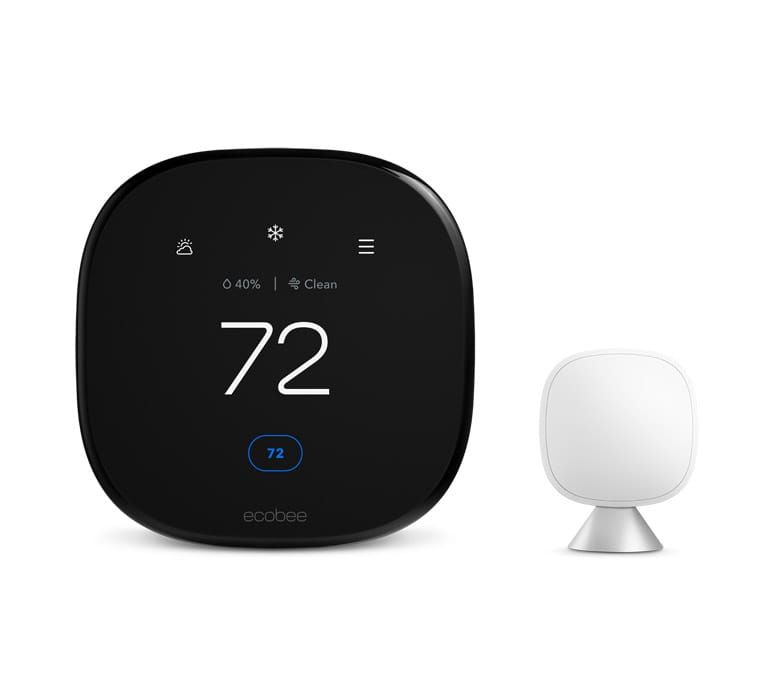
ecobee has been the default HomeKit thermostat recommendation for years, and the Premium model at $249.99 earns that reputation. It has a 4.2-inch touchscreen wrapped in a zinc alloy body that actually feels like a piece of hardware, not a plastic toy. It ships with a SmartSensor for monitoring temperature and occupancy in a second room, a built-in air quality monitor that tracks CO2 and VOCs, and — this surprised me — a built-in speaker that works as a Siri device. You can ask Siri questions directly from your hallway thermostat.
Is that necessary? No. Is it oddly convenient when your hands are full of groceries? Absolutely.
Here is where it stings, though. ecobee still has not added support for Apple’s new Adaptive Temperature feature in iOS 26. For a thermostat that costs $250, that omission is hard to ignore.
ecobee Smart Thermostat Essential: The Budget Play
If $250 sounds steep for something that lives on your wall, ecobee released the Essential in 2025 for $129.99 and it covers the fundamentals without apology. Full HomeKit support, a 2.8-inch color touchscreen, humidity detection, and scheduling that learns your preferences over time. You lose the room sensor, the air quality monitor, and the built-in speaker. For most single-zone homes, you will never miss any of that.
Build quality feels like a $130 thermostat — functional, not premium. The smaller display means more tapping through menus and less at-a-glance information. But if your Apple Home priorities are Siri control and geofencing automations, this gets you there at half the price.
 Ad
AdThe Aqara W200: A New Contender With a Trick Nobody Else Has
Aqara launched the W200 on April 7, 2026 for $159.99, and it immediately became the most interesting HomeKit thermostat you can buy. It is the first and only thermostat that supports Apple’s Adaptive Temperature feature in iOS 26. That feature automatically adjusts your climate based on whether you are home, asleep, away, or traveling, and it uses predicted arrival times from your daily patterns to pre-condition the house before you walk through the door.
It also doubles as a Zigbee and Thread smart home hub, which means it can control other Aqara and Matter devices from its 4-inch curved glass touchscreen. A built-in mmWave radar sensor wakes the display when you approach. At $159.99, it undercuts the ecobee Premium by nearly a hundred dollars while offering a headline feature ecobee does not have yet.
But there is always a catch. Adaptive Temperature requires every member of your household to run iOS 26 or watchOS 26, plus an Apple TV or HomePod as a home hub on the latest software. If anyone is holding onto an older device, the feature simply will not activate. That is an Apple limitation, not an Aqara one, but check your household before you buy specifically for this feature. If you are already running a proper home hub, you are probably fine.
Honeywell Home T9: The Quiet Workhorse
Honeywell’s T9 at around $169 does not generate headlines, but it generates consistent comfort. Native HomeKit support, its own proprietary room sensors with a 200-foot range that eclipses ecobee’s shorter Bluetooth reach, and Energy Star certification. The T9 can manage up to 20 sensors scattered across your home, which matters if you have rooms that run ten degrees hotter or cooler than the thermostat’s location.
Do not expect design awards from the interface. The Honeywell Home app feels a generation behind ecobee’s polish, and the physical unit looks like it belongs in a rental property. But that sensor range is genuinely superior, and for larger homes with uneven heating, the T9 solves a problem the others cannot reach.
What About the Nest Learning Thermostat?
Google’s Nest Learning Thermostat 4th Generation finally works with Apple Home through Matter, and at $279.99 it is the most expensive option on this list. The hardware is gorgeous — polished steel and glass that looks like someone actually cared about how a thermostat sits on a wall.
The problem for Apple Home users is significant. Matter only passes through basic controls. Nest’s room sensors do not appear in the Home app. The learning algorithms, detailed energy reports, and granular scheduling all stay locked in Google Home. You are paying the highest price on this list for the thermostat that gives Apple Home the least functionality. If you have already committed to Apple’s ecosystem, the Nest is a tough sell unless you also run Google services on the side. According to Apple’s HomeKit accessory framework, thermostats expose target temperature, current temperature, and heating or cooling mode characteristics — but anything beyond those basics depends on the manufacturer’s native integration, which is exactly where Matter-only devices fall short.
At a Glance: How These Five Stack Up
The following table compares the five HomeKit thermostats discussed in this article across the attributes that matter most for Apple Home owners.
| Thermostat | Price | HomeKit Type | Adaptive Temp | Room Sensors in Home |
|---|---|---|---|---|
| ecobee Premium | $249.99 | Native | No | Yes (SmartSensor) |
| ecobee Essential | $129.99 | Native | No | No |
| Aqara W200 | $159.99 | Native | Yes (first) | No |
| Honeywell T9 | ~$169 | Native | No | No |
| Nest 4th Gen | $279.99 | Matter | No | No |
Quick-Action Checklist
- Confirm your HVAC system uses 24V wiring, which covers roughly 85 percent of homes in the US.
- Check whether your system has a C-wire. If not, budget an extra $30 for an adapter.
- Verify every household member runs iOS 26 or later if you want Adaptive Temperature.
- Confirm your Apple TV or HomePod home hub is updated to the latest software.
- Add the thermostat to Apple Home, then build your first geofencing automation: temperature down when the last person leaves, back up when the first person arrives.

Related Posts
How to Set Up HomePod mini and Change Its WiFi Network
Apr 17, 2026
Ring Won’t Support Apple HomeKit — These Workarounds Work
Apr 16, 2026
Your Apple TV 4K Is a Real Game Console — Here's How to Set It Up Right
Apr 15, 2026