
🎧 Listen to this article
Prefer to listen? An audio version of this article is available for accessibility and convenience.
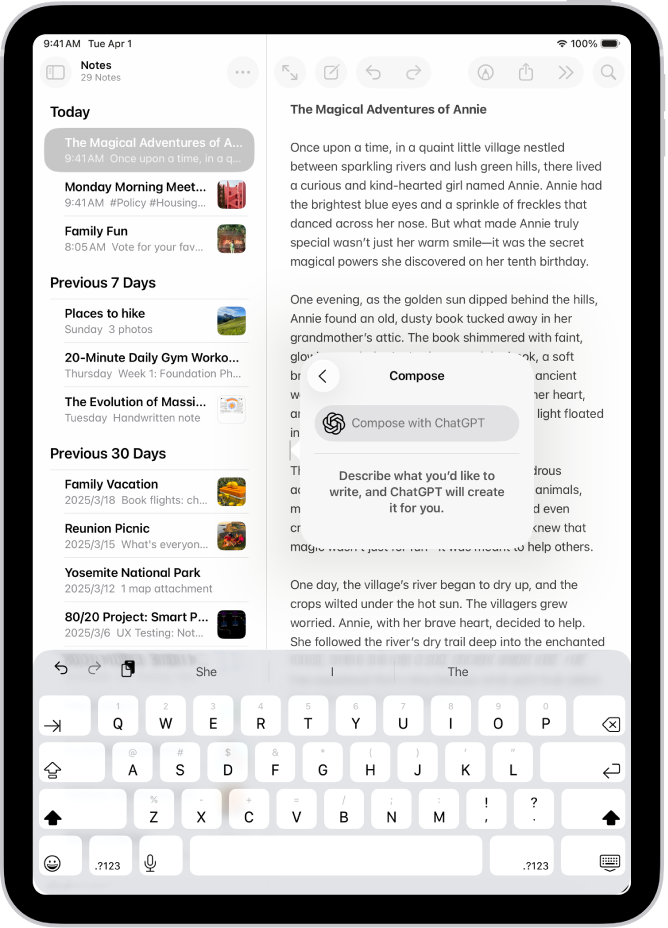
Apple Notes in iPadOS 26 got a genuine upgrade. The app now exports to Markdown, gained a new Reed pen for Apple Pencil users, and syncs collaboration changes faster than earlier versions did. For a lot of people, it is genuinely enough now.
But here is the thing. If you write with an Apple Pencil and want your handwriting to feel precise and fully searchable, Apple Notes will start frustrating you within a week. If your notes need to plug into a knowledge graph or a workspace with databases and linked tasks, you will hit a ceiling fast. And if you are a student who records lectures while writing in the margins, Apple Notes does not even try.
Well, the right app is not the one with the most features. It is the one built for how you actually think. Here is how to figure that out.
 Ad
AdIf You Mostly Type, Not Draw
Bear is the app I would point to first for typed-note takers. Markdown-based, minimal, and genuinely fast. The inline Markdown hides as you type — formatting disappears into clean text rather than cluttering your screen. Tags use a hashtag system that supports nesting, so tagging a note with #work/projects/clientname automatically surfaces it at every level of that hierarchy.
Bear’s cross-device sync requires Bear Pro at $29.99 a year. The free tier keeps you locked to a single device, which defeats the point if you move between your iPad, iPhone, and Mac. The 14-day trial is real, and the annual price is reasonable for what you get.
Craft is the block-based alternative for writers who like to move ideas around. Each paragraph, image, and heading is a discrete object you can rearrange, link, or convert to a different type. Writers who have used Notion will recognize the pattern, but Craft is faster and more focused on writing than on workspace management. The free tier limits you to 1,500 blocks and removes cross-device sync, so you will hit the ceiling quickly if you use it daily. Paid plans start at $8 a month.
If You Write With an Apple Pencil
Straight talk — GoodNotes 6 is the best handwriting app for iPad. The ink engine is accurate and responsive, the template library covers everything from graph paper to music notation staves, and the AI handwriting search works. You can scrawl a word in a meeting six months ago and find it across every notebook in seconds. GoodNotes starts free for up to three notebooks, with the Essential plan at $11.99 a year for unlimited files.
The pricing history matters. GoodNotes switched from a one-time purchase to a subscription with version 6, and longtime users who bought GoodNotes 5 were not pleased. A Special Edition plan at $35.99 one-time exists for people who refuse subscriptions on principle, but it is Apple-ecosystem-only and will not include future AI features. Make peace with that tradeoff before you commit.
Notability has one feature GoodNotes does not: audio recording that syncs to your notes in real time. As you write, Notability timestamps each stroke. On playback, your handwriting animates on screen at the exact moment you wrote it. Tap any word in the auto-generated transcript and the audio scrubs back to that precise second. For students sitting in lectures, this is not a nice-to-have — it is the reason you pick Notability over anything else. The audio recording features require the Plus plan at $19.99 a year.
 Ad
AdIf Your Notes Need to Connect to Everything Else
Notion is the answer most people reach for first, and it earns its reputation for flexibility. Notes, databases, task managers, calendars, and wikis all share the same workspace. The friction is that your notes often end up buried inside a system that takes twenty minutes to configure before you have typed a single word. Coming in fresh just for note-taking? The blank canvas is brutal, and the mobile experience on iPad is noticeably slower than on desktop.
Obsidian is the app that surprises people once they try it. Notes are stored as plain Markdown files on your device — no proprietary format, no vendor lock-in, no losing your library if the company pivots or the service shuts down. The Knowledge Graph turns your notes into a visual map of connected ideas, which sounds abstract until you see a cluster of linked concepts emerge without you having to organize a single folder. Researchers and long-form writers often describe the moment Obsidian clicks as something they cannot go back from. For someone who needs quick reminders and grocery lists, it is wildly overkill.
Obsidian is free for personal use. Cross-device sync costs $4 a month if you want it. The base app runs entirely offline, no account required.
Here is how the main options compare at a glance.
Here is how the main note-taking apps compare across the decisions that matter most for iPad users.
| App | Best For | Apple Pencil? | Free Tier? | Paid Entry |
|---|---|---|---|---|
| Apple Notes | General users, iCloud sync | Decent | Yes (full) | Free |
| GoodNotes 6 | Handwriting-first users | Excellent | Yes (3 notebooks) | $11.99/year |
| Notability | Students recording lectures | Good | Yes (limited) | $19.99/year |
| Bear | Writers and Markdown lovers | No | Yes (no sync) | $29.99/year |
| Craft | Structured writing and planning | No | Yes (1,500 blocks, no sync) | $8/month |
| Notion | Users who want a full workspace | No | Yes (unlimited pages) | Free/$10 month |
| Obsidian | Researchers, linked knowledge | No | Yes (fully unlimited) | Free (sync $4/mo) |
The One You Are Probably Overlooking
Apple Notes. That probably sounds backwards after everything above, but Apple Notes in iPadOS 26 earned a genuine second look. The Markdown export means you can pull notes out cleanly if you ever switch. Quick Notes — a pinned scratchpad you summon from anywhere in iPadOS with a swipe from the corner — finally works the way it was always supposed to. Smart Folders auto-sort notes based on tags, dates, or location without any manual work. And everything syncs through iCloud instantly, with no subscription, no storage tiers to think about, and no configuration before it just works.
Apple Notes fails two types of users: Apple Pencil writers who need GoodNotes-level precision, and power users who want their notes wired into databases or a linked knowledge system. For everyone else — especially someone who just got their first iPad and has not yet committed to a workflow — starting with Apple Notes is not settling. It is the sensible move.
If you are putting together a full iPad productivity setup, the accessories that can genuinely replace your laptop are worth knowing about. And if you have a Magic Keyboard attached and have not explored its hidden shortcut layer, that is worth ten minutes before you download anything else.
Pick the app that matches how your brain already works, not the one with the longest feature list. The note app you actually open beats the perfect one you never quite got around to setting up.

Related Posts
Every Apple Pencil and the iPad It Actually Works With
Apr 15, 2026
Every Way to Take a Screenshot on Your iPad in iPadOS 26
Apr 14, 2026
Your iPad Moves Files Six Ways and You're Probably Using One
Apr 08, 2026