

🎧 Listen to this article
Prefer to listen? An audio version of this article is available for accessibility and convenience.
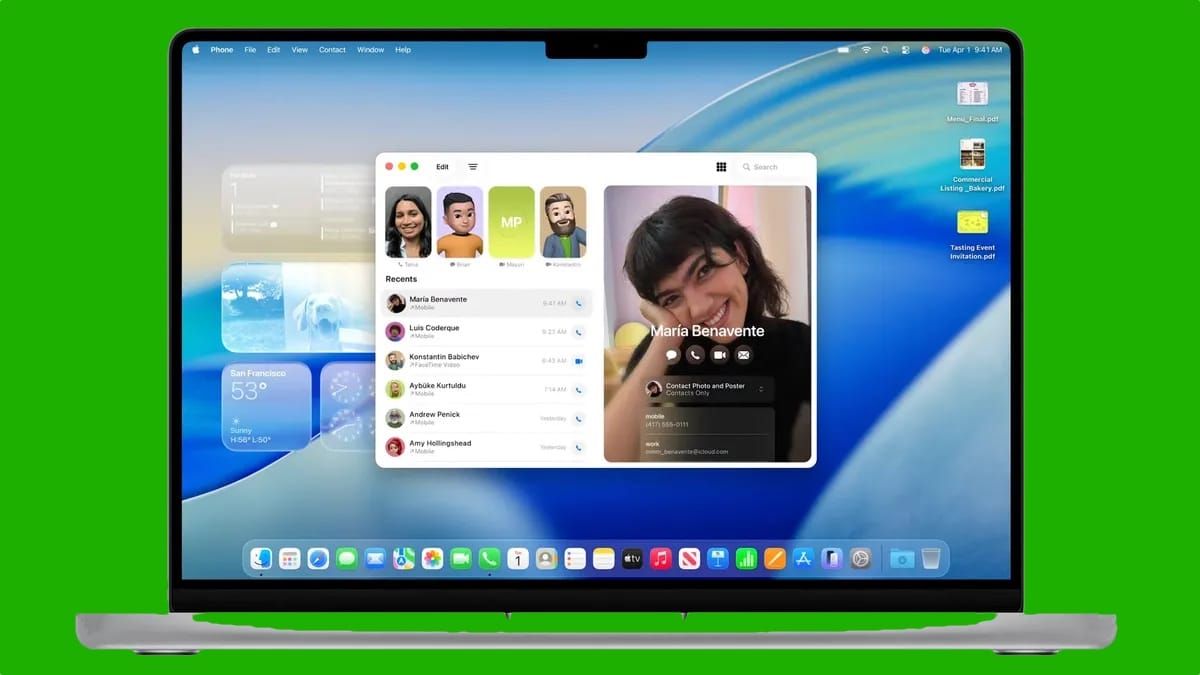
iPhone Mirroring lets you view, control, and fully interact with your iPhone from your Mac — no cable required, no AirPlay stream, no phone in hand. You can launch apps, reply to messages, drag files between devices, and clear notifications, all through your Mac’s keyboard and trackpad. The setup takes about two minutes.
Here is the part Apple does not advertise loudly enough: this is not screen casting. When you control something in iPhone Mirroring, the iPhone actually does it. And in macOS Tahoe 26, Live Activities from your iPhone — delivery tracking, flight status, sports scores — now surface in your Mac’s menu bar, right where you are already looking, instead of on a device sitting face-down on your desk.
 Ad
AdWhat iPhone Mirroring Actually Does
Think of it less like casting your phone screen to a TV and more like running a tiny second Mac in a window. Your iPhone’s display appears full and resizable on your screen. Every tap, scroll, swipe, and keyboard input you make through your Mac controls the iPhone directly. On M-series Macs the interaction feels tight enough that you stop thinking about the Wi-Fi connection driving it — the lag essentially disappears.
Notifications are the part most users underestimate. iPhone notifications route through macOS’s Notification Center with a small iPhone badge so you know which device they came from. Dismiss one on your Mac, and it clears from your iPhone too. That alone cuts out a specific kind of friction: the reflex of picking up your phone to swipe away a notification that does not actually need your attention.
Drag-and-drop between devices is where iPhone Mirroring surprises people. Drag a photo out of the Photos app on the iPhone Mirroring window and drop it directly into a Mail window, a Slack message, or your Mac desktop. It moves as a single gesture, no intermediate steps. Drop a file from your Mac into a Files app window open in the mirroring session and it transfers to your iPhone. For moving specific files you already have in front of you, this is faster than AirDrop between devices, which requires both sides of the transfer to be initiated separately.
Well, think about what you would normally do: unlock the phone, navigate to the file, open the share sheet, select AirDrop, pick your Mac, accept on the Mac. That is six steps. iPhone Mirroring collapses it to one drag. Numbers do not lie, and that kind of efficiency is why people who start using this feature tend to leave it running in the background.
One thing worth flagging before you commit: iPhone Mirroring is not available in the European Union. Apple disabled it due to regulatory requirements, and if your Mac’s region is set to an EU country, the app simply will not open. That is a strange limitation to discover after you are already expecting it to work, and it is Apple’s policy call, not a hardware gap.
 Ad
AdSetting It Up
The requirements are specific, so verify these before you look for the app. Your Mac needs macOS Tahoe 26 and must have Apple Silicon — M1 chip or newer — or an Apple T2 Security Chip. Your iPhone needs iOS 26 or later, a passcode enabled, and must be signed into the same Apple Account as your Mac with two-factor authentication active. Both devices need Bluetooth and Wi-Fi on, and should stay within about 30 feet of each other.
With that in order: find iPhone Mirroring in your Applications folder or Dock. Follow the on-screen prompts and unlock your iPhone when it asks. Then choose your authentication preference — automatic via Touch ID on compatible Macs, or a manual confirmation each time. If your Mac is in a shared space, manual is the safer call. If your Mac is private, automatic saves a step every time you want to jump in.
Once the session is running, your iPhone stays locked and physically inaccessible. The screen goes dark. No one who picks it up during a mirroring session can see what you are doing on it. The Mac logs activity locally — when your iPhone was accessed through mirroring and for how long — so there is a record if you ever need to review it.
The Live Activities Upgrade
macOS Tahoe 26 added something that makes iPhone Mirroring useful even when you are not actively using it. Live Activities from your iPhone — a DoorDash delivery countdown, a flight status, an NBA score — now appear in your Mac’s menu bar as a compact badge. Double-click any of them and iPhone Mirroring opens directly to that app’s full view.
This is a meaningful shift. Sidecar gives you more Mac screen space by extending your display to an iPad. iPhone Mirroring’s Live Activities integration pulls iPhone context into your Mac environment without you opening anything — the information comes to you while you are working, and you only interact with it if you choose to.
What It Will Not Do
iPhone Mirroring cannot access your iPhone’s camera or microphone. Any app that tries to use them while you are mirroring will get blocked — this means FaceTime video calls, camera apps, and anything that needs audio input from the iPhone side. DRM-protected streaming apps like Netflix, Disney+, and Hulu may show a blank screen because they detect the screen capture scenario and enforce playback restrictions.
You cannot run iPhone Mirroring at the same time as AirPlay, Sidecar, or Continuity Camera on the same iPhone. Those features are mutually exclusive. Starting any of them deactivates iPhone Mirroring until you end the other session. If you switch between these workflows frequently, plan around that one-at-a-time constraint.
One friction point that trips people up on the first session: the Home Screen gesture. Swiping up from the bottom of the iPhone Mirroring window does not behave exactly like swiping up on the physical device. You will find your way around it quickly, but the first time you try it and nothing happens the way you expect, it is worth knowing that is normal, not broken.
Quick-Action Checklist
Before you open the app:
- Mac running macOS Tahoe 26 with M1 chip or newer, or Apple T2 chip
- iPhone running iOS 26 or later with a passcode set
- Both devices signed into the same Apple Account with two-factor authentication enabled
- Bluetooth and Wi-Fi active on both devices, within 30 feet of each other
To set up iPhone Mirroring:
- Open iPhone Mirroring from Applications or Dock
- Follow the prompts and unlock your iPhone when asked
- Choose automatic authentication with Touch ID or manual confirmation
- Approve iPhone notification access in macOS when prompted
To use drag-and-drop:
- Open the source file or photo in the mirroring window
- Click, hold, and drag it out of the mirroring window
- Drop it into any open Mac app or window

Related Posts
How to Screen Record on Mac in macOS 26
Apr 29, 2026
Use Sidecar to Turn Your iPad Into a Second Mac Display
Apr 23, 2026
Mac Studio M4 Max vs Mac mini M4: Which Desktop Actually Fits Your Work
Apr 22, 2026