
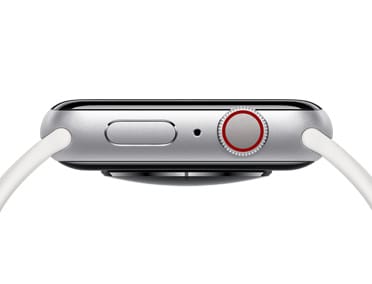

The rubber Apple Watch Sport Band sitting on your wrist right now likely contains PFAS, the synthetic "forever chemicals" linked to cancer, hormone disruption, and immune suppression. A peer-reviewed University of Notre Dame study published in Environmental Science & Technology Letters found perfluorohexanoic acid (PFHxA) concentrations above 16,000 parts per billion in fluoroelastomer watch bands, and Apple's Sport Band, Nike Sport Band, and Ocean Band are all made from that exact material.
Here's the thing, though: Apple sells bands without these chemicals for the same price, and the swap takes about four seconds. The tricky part is knowing which bands are clean, because Apple does not label PFAS content anywhere on the box, in the Apple Store app, or on its website. I went through every first-party band Apple currently sells, matched each one against the research, and built the clearest guide I could find anywhere on the internet for figuring out what stays on your wrist and what goes in a drawer.
 Ad
AdWhat the Notre Dame Researchers Actually Found
In December 2024, researchers led by Graham Peaslee at the University of Notre Dame published findings that shook the wearable industry. They purchased 22 smartwatch and fitness tracker bands from various brands, tested each one using particle-induced gamma-ray emission (PIGE) spectroscopy, then confirmed results with liquid chromatography-tandem mass spectrometry. The study was anonymized, so brand names were not published. But the material-level results were damning.
Every single fluoroelastomer band tested positive for PFAS.
The surface fluorine levels on fluoroelastomer bands ranged from 29% to 91%. For context, firefighter gear, which is explicitly designed to withstand chemical exposure, contains about 2% surface fluorine. The primary compound detected, PFHxA, is the third most common PFAS found in human blood, according to the study authors. Professor Peaslee put it bluntly: "The levels are so high that we shouldn't be using this material."
One result that caught my attention: the cheapest bands were the cleanest. All five bands priced under fifteen dollars contained less than 1% fluorine. The most expensive bands, priced above thirty dollars, contained the highest concentrations at 50% to 90% surface fluorine. Fluoroelastomer is a premium material, and that premium comes with an unwanted chemical bonus.
Why This Matters for Your Skin
The natural follow-up question: can PFAS from a watch band actually get into your body? A June 2024 study from the University of Birmingham, published in Environment International, tested 17 PFAS compounds against 3D human skin models. Fifteen of the seventeen showed substantial dermal absorption. PFOA, the most regulated PFAS compound, showed 13.5% absorption into the bloodstream with another 38% retained in the skin for potential later uptake.
Shorter-chain compounds absorbed even faster. PFPeA hit 58.9% absorption. That matters because the ACS notes that over 50% of PFHxA exposure, the specific compound in watch bands, occurs through dermal absorption. Translation: your skin is not a reliable barrier against these chemicals.
Now factor in how people actually wear fitness bands. A 2020 study found the median wear time is 11.2 hours per day. The skin under a watch band stays warm, moist, and occluded. During workouts, you sweat directly onto the band material, and heat accelerates chemical transfer. The Notre Dame researchers specifically noted that "chemicals move more quickly in heat," which is precisely the condition your Sport Band sits in during every run, every gym session, every walk on a warm afternoon.
Which Apple Watch Bands Contain PFAS
Apple confirms that three of its band types are made from fluoroelastomer:
- Sport Band ($49) — Apple’s most popular band, the iconic smooth rubber strap that ships with most Apple Watch models
- Nike Sport Band ($49) — the perforated version with Nike branding
- Ocean Band ($99) — the stretchy tubular band designed for Apple Watch Ultra diving and water sports
These three bands are specifically named in the January 2025 class-action lawsuit Cavalier v. Apple, Inc. (Case No. 5:25-cv-00713), filed in the U.S. District Court for the Northern District of California. The plaintiffs allege that Apple marketed these bands as part of a healthy lifestyle while knowing they contain chemicals with documented health risks.
Apple’s response? "Apple Watch bands are safe for users to wear." The company says it works with independent labs to test its materials and that its analysis indicates the bands are safe during product use. But here’s where the corporate messaging gets interesting: Apple also acknowledges that PFAS is present in some of its products, describes PFAS as "harmful," and has publicly committed to phasing out all PFAS from its products over time. You cannot simultaneously call something harmful and claim it is safe. That contradiction sits at the heart of the lawsuit, which remains in early litigation as of February 2026 with no resolution.
Safe Bands That Cost the Same or Less
The good news is genuinely good. Apple sells multiple band types that do not use fluoroelastomer, and the most direct replacement costs exactly the same price as the Sport Band.
The Solo Loop ($49) is made from liquid silicone rubber. The Notre Dame study found silicone bands had little to no detectable PFAS. It feels slightly different on the wrist than the Sport Band. A bit more pliant, a touch less rigid. The fit is stretchier since there is no clasp. It slides over your hand and onto your wrist like a thick rubber bracelet. Sizing matters here more than with any other Apple band, because there is no adjustment mechanism. If you pick the wrong size, it either cuts into your skin or slides around. Apple’s measuring tool is worth using.
The Sport Loop ($49) is woven nylon with a hook-and-loop fastener. No elastomer at all. It breathes better than any rubber band during workouts, dries faster after washing your hands, and the Velcro-style closure adjusts infinitely. I think it is the most underrated band Apple makes, honestly. The only friction: the hook-and-loop side can catch on sleeve cuffs if you push your hand through a tight sweater.
If you want something dressier, the Milanese Loop ($99) is stainless steel mesh. Zero organic chemicals, zero PFAS, zero concern. The magnetic closure is elegant and adjustable, though it does pull arm hair occasionally. If you already own an Apple Watch band collection, our guide to every band that fits your Apple Watch model covers compatibility across every series from the original to Ultra 3.
For Apple Watch Ultra owners, the Alpine Loop ($99) and Trail Loop ($99) are both textile-based with titanium hardware. Neither contains fluoroelastomer. The Ocean Band is the Ultra strap to avoid if PFAS concerns you.
The table below compares Apple's current first-party band types by material, PFAS risk, and price point so you can make a quick decision.
| Band Type | Material | PFAS Concern | Price |
|---|---|---|---|
| Sport Band | Fluoroelastomer | Yes | $49 |
| Nike Sport Band | Fluoroelastomer | Yes | $49 |
| Ocean Band (Ultra) | Tubular elastomer | Yes | $99 |
| Solo Loop | Liquid silicone rubber | No | $49 |
| Braided Solo Loop | Recycled polyester + silicone | No | $99 |
| Sport Loop | Woven nylon | No | $49 |
| Milanese Loop | Stainless steel mesh | No | $99 |
| Alpine Loop (Ultra) | Textile + titanium hook | No | $99 |
| Trail Loop (Ultra) | Textile + titanium lugs | No | $99 |
The Regulatory Patchwork That Leaves You on Your Own
No U.S. federal regulation currently prohibits PFAS intentionally added to consumer products worn on skin. The EPA has authority to review new PFAS uses under the Toxic Substances Control Act, but watch bands fall into a gray area that nobody has explicitly addressed. The FDA released a report in January 2026 citing "significant" PFAS safety data gaps in cosmetics and skin-contact products, which is about as close to official alarm as a federal agency gets without actually banning something.
States are moving faster. Maine now prohibits sale of specific products with intentionally added PFAS as of January 1, 2026, expanding to all products by 2030. Minnesota’s Amara’s Law bans PFAS in cosmetics, children’s products, and cookware, expanding to all consumer products by 2032. California’s PFAS-Free Cosmetics Act already bans intentionally added PFAS in cosmetics. Whether any of these laws cover watch bands specifically depends on how regulators classify elastomer wrist straps, and that question remains unsettled.
The European Union has effectively banned PFHxA, the specific compound found in the watch bands. That same compound remains completely unregulated in the United States. France banned PFAS in clothing and textiles as of January 1, 2026. Denmark already prohibits PFAS in waterproofing agents. If you are reading this from Europe, regulatory protection is arriving. In the U.S., you are largely on your own.
Join The Inner Circle For Serious Apple Users
Exclusive Apple tips. Free to join.
What I Would Actually Do
I am not a toxicologist, and I’m not going to pretend that wearing a Sport Band for a week is the same as drinking contaminated water. The dose makes the poison, and the specific dose from watch band wear has not been measured in a controlled human study. That research gap is real and important.
But the precautionary math is straightforward. The Solo Loop costs the same as the Sport Band. The Sport Loop costs the same. Both are PFAS-free. Swapping out takes less time than reading this sentence. When the alternative costs nothing and the potential risk involves chemicals that accumulate in your body over decades and do not break down, the rational move is obvious. Apple itself plans to remove these chemicals from its entire product line. I’d rather not wait for the corporate timeline to catch up with what the science already suggests.
If you already own a Sport Band and like the feel, the Solo Loop is the closest match in terms of flexibility and weight. If you prioritize breathability, the Sport Loop wins. If you want to understand how different band materials change the daily experience of wearing an Apple Watch, that deep dive covers the tactile differences between every option. And if your Apple Watch tracks health data you depend on, like heart rhythm notifications, it’s worth making sure the band delivering that data to your wrist isn’t quietly working against you.

Related Posts
Apple Watch Cellular vs GPS: The Honest Buying Guide for Every Model in 2026
Mar 01, 2026
The Apple Watch Workout Settings That Quietly Change How You Train
Feb 28, 2026
Every Apple Watch That Runs watchOS 26 and the Features Each One Gets
Feb 24, 2026