
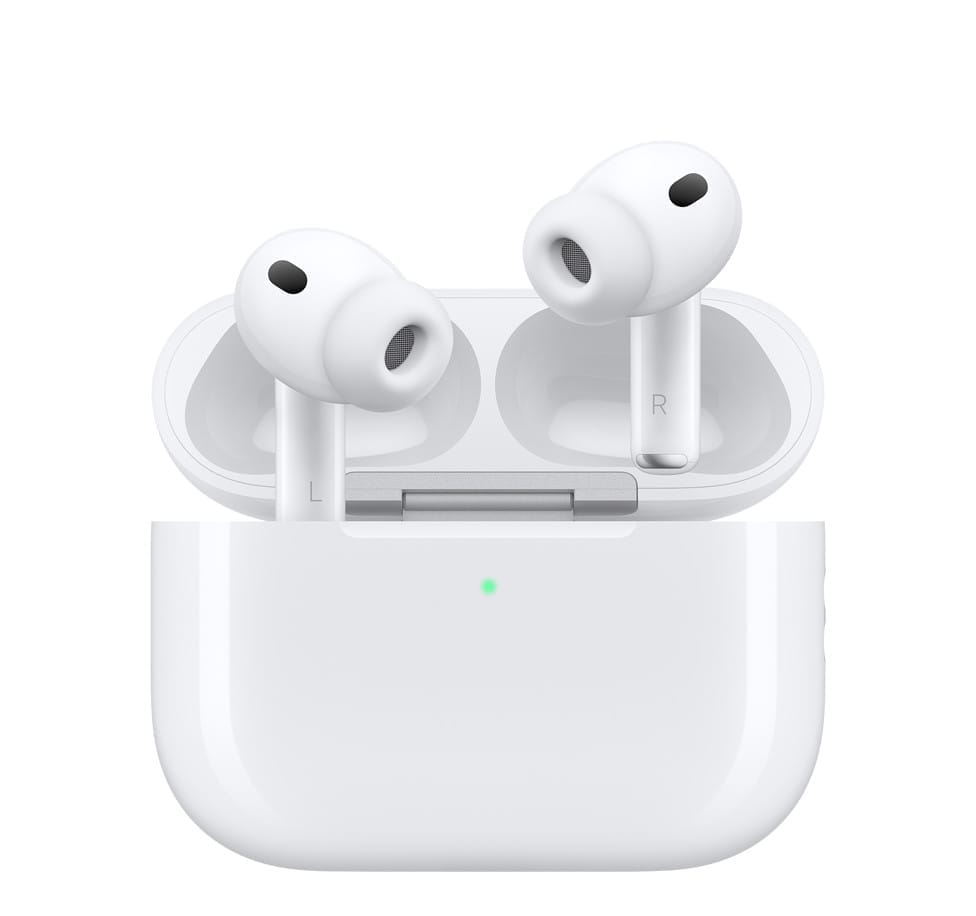

AirPods Pro 3 and AirPods Pro 2 both run on the same Apple H2 headphone chip, both cost $249 at retail, and both support every headline feature Apple has marketed for the last two years — Adaptive Audio, Conversation Awareness, Personalized Spatial Audio. On paper, they look like the same product with a new model number. They are not.
The real gap between these two models lives in the physical hardware Apple redesigned around that shared chip: a repositioned driver, a multiport acoustic architecture that controls how air carries sound into your ear, foam-infused silicone tips in five sizes instead of four, and ultra-low noise microphones that feed dramatically better data to the noise cancellation engine. The Apple H2 chip is doing the same math in both models, but the AirPods Pro 3 give it better inputs and a better stage to work with. That distinction matters more than most spec sheets will tell you.
So which one should you actually spend money on? Well, that depends on what you care about. I am going to walk through every meaningful difference — sound, noise cancellation, battery, health sensors, fit — so you can make the call without guessing.
 Ad
AdThe Noise Cancellation Improvement Is Not Subtle
Apple claims the AirPods Pro 3 cancel up to twice as much noise as the AirPods Pro 2. I expected the kind of marginal improvement you need a quiet room and a test track to notice. That is not what happens. The difference is obvious the moment you put them in on a busy street or a loud office. External reviewers confirmed this — Engadget rated the Pro 3 at 90 out of 100, specifically calling the ANC improvement “obvious and observable.”
The reason is not a faster chip. It is better microphones. The AirPods Pro 3 use ultra-low noise microphones that capture environmental sound with less distortion, which lets the H2 chip build a more accurate anti-noise signal. Think about it — the chip was never the bottleneck. The microphones were.
For the AirPods Pro 2, noise cancellation still works well in most environments. Airplanes, coffee shops, moderate street noise — it handles all of that. But in louder, more unpredictable environments, the Pro 3 pulls noticeably ahead. If you work in open offices or commute on public transit, you will feel the upgrade instantly.
Battery Life Is a Trade-Off, Not a Straight Win
Per-charge battery life is where the AirPods Pro 3 dominate. With Active Noise Cancellation enabled, you get up to eight hours per charge versus six hours on the AirPods Pro 2. That is a 33 percent jump. In Transparency mode, the gap widens even further — ten hours on the Pro 3 versus roughly six on the Pro 2, a 67 percent improvement that matters enormously for anyone using the hearing aid feature throughout the day.
Here is where it gets interesting. Total battery life with the charging case actually favors the older model. The AirPods Pro 2 case holds up to 30 total hours. The AirPods Pro 3 case? Twenty-four hours. Apple made the case lighter — 44 grams versus nearly 51 — but that weight savings came at the cost of case capacity.
Does that matter in practice? For most people, no. Eight hours of listening time per charge means you are recharging during a break, not mid-commute. But if you travel frequently and depend on your earbuds for 12-plus-hour flights without access to a charger, the Pro 2 technically stretches further between charges of the case itself.
Heart Rate Sensing Changes What AirPods Are For
The AirPods Pro 3 have a PPG heart rate sensor built into the earbuds. It pulses infrared light 256 times per second and tracks your heart rate across more than 50 workout types in the Apple Fitness app. The AirPods Pro 2 do not have this sensor. Period.
Why does this matter? If you already wear an Apple Watch during workouts, you might think it is redundant. But earbuds stay in contact with skin differently than a wrist-worn device, and some athletes — cyclists, weightlifters, anyone wearing gloves — get more consistent readings from an in-ear sensor. You can also track heart rate without wearing anything on your wrist, which is genuinely useful for people who find watches uncomfortable during exercise. If you want a deeper look at how the heart rate tracking works in practice, Zone of Mac has a full walkthrough of AirPods Pro 3 heart rate tracking during workouts.
 Ad
AdHearing Health Works on Both — But Better on One
Apple’s FDA-authorized hearing health suite — the hearing test, hearing aid mode, and hearing protection — runs on both the AirPods Pro 2 and AirPods Pro 3. Apple rolled these features to the Pro 2 via a software update in fall 2024, so you do not need the newer model to access them.
The Pro 3 improves the experience in two specific ways. First, Conversation Boost activates automatically in noisy environments on the Pro 3. On the Pro 2, you toggle it manually. That automatic switching matters more than it sounds — when you are wearing hearing aids all day, fumbling with settings every time someone talks to you gets old fast. Second, battery life in hearing aid mode is ten hours on the Pro 3 versus six on the Pro 2. For all-day wearers, that is the difference between making it through a full workday and needing a mid-afternoon recharge.
Apple’s hearing test itself uses pure-tone audiometry developed from over 150,000 real-world audiograms, and the ANC seal simulates clinical testing conditions. Results are stored privately in the Health app. Both models deliver this identically.
The Fit Feels Different — And That Matters
The AirPods Pro 3 earbuds are physically narrower: 19.2 millimeters wide compared to 21.8 millimeters on the Pro 2. The stems are shorter. The overall feel in the ear is subtly different, and people with smaller ears will notice the improvement immediately.
Apple also switched from plain silicone ear tips to foam-infused silicone and added a fifth size — XXS. This is not a minor accessory change. Foam-infused tips create a better passive seal, which improves both noise isolation and bass response before the ANC even kicks in. One thing to know: the ear tips are not interchangeable between models. Macworld confirmed this directly. If you have a drawer full of spare Pro 2 tips, they will not fit the Pro 3.
The IP rating went from IP54 on the Pro 2 to IP57 on the Pro 3, adding dust resistance and stronger water protection. For gym use, outdoor runs in rain, or anyone who sweats heavily, that is a practical upgrade. If you have been getting the most out of your AirPods Pro settings, the hidden configuration options in iOS apply to both models and are worth revisiting regardless of which pair you own.
Here is how the two models stack up across the specs that affect daily use.
| Feature | AirPods Pro 3 | AirPods Pro 2 |
|---|---|---|
| Chip | Apple H2 | Apple H2 |
| Active Noise Cancellation | 2x better than Pro 2 | 2x better than original Pro |
| Battery (ANC, per charge) | Up to 8 hours | Up to 6 hours |
| Battery (total with case) | Up to 24 hours | Up to 30 hours |
| Heart Rate Sensor | Yes (PPG, 50+ workouts) | No |
| Hearing Aid Battery | Up to 10 hours | Up to 6 hours |
| Ear Tip Sizes | 5 (XXS–L, foam-infused) | 4 (XS–L, silicone) |
| IP Rating | IP57 | IP54 |
| Case UWB Chip | U2 (longer Find My range) | U1 |
| Live Translation | Yes (5 languages at launch) | Added later via update |
| Street Price (Feb 2026) | ~$199–$229 | ~$150–$170 |
Who Should Buy Which
If you do not own any AirPods Pro and you are buying fresh, get the AirPods Pro 3. The ANC improvement alone justifies the price, and you get heart rate sensing, better fit options, and stronger water resistance on top of it. At $199 to $229 on sale, it is the better investment for the next three to four years.
If you already own the AirPods Pro 2 and they work well for you? This is where it gets honest. The Pro 2 are still excellent earbuds. They still run the same Apple H2 chip, still receive software updates, and still sound very good. Unless you specifically want the heart rate sensor, need dramatically better ANC for loud environments, or use hearing aid mode daily and need that extra four hours of battery, the Pro 2 will serve you well through at least another year. At their current street price of $150 to $170, they remain one of the strongest values in wireless earbuds.
One more thing worth knowing. Multiple sources — MacRumors, Tom’s Guide, and others — report that Apple is developing a higher-end AirPods Pro model for later in 2026, potentially with a new Apple H3 chip and infrared cameras for gesture recognition. If you are on the fence about the Pro 3, that model might be worth watching for. But waiting for unreleased Apple products is a game that never ends, and the Pro 3 are available and excellent right now.

Related Posts
Your AirPods Max Are Collecting Grime You Cannot See
Mar 04, 2026
Your AirPods Have Dozens of Hidden Settings on Your iPhone — Here Is Every One
Mar 03, 2026
Your AirPods Have Three Spatial Audio Modes You Probably Never Switched
Mar 03, 2026