

🎧 Listen to this article
Prefer to listen? An audio version of this article is available for accessibility and convenience.
The Apple HomePod 2nd generation is a genuinely beautiful speaker that produces room-filling Spatial Audio with Dolby Atmos support, doubles as a HomeKit and Matter smart home hub with Thread networking, and handles Apple Music playback with lossless audio up to 24-bit/192 kHz. For Apple households that live inside Apple Music and HomeKit, nothing else sounds this good while also controlling your lights.
But here's the problem. The HomePod launched in January 2023 with an Apple S7 chip, Wi-Fi 4 networking, and the same Siri that has frustrated people for years. It is now March 2026. Apple has not updated the hardware. Not once. And with a rumored Apple Home display device (the "HomePad") reportedly arriving this spring with an A18 chip and Apple Intelligence, the $299 HomePod sits in an uncomfortable position: still great at what it does, but visibly aging in ways that matter.
I want to be upfront about something. The HomePod is the best-sounding smart speaker in its price class. That part is not a debate. What is a debate is whether "best-sounding" is enough when the brain inside it runs on a chip from the Apple Watch Series 7.
 Ad
AdWhat the HomePod still does brilliantly
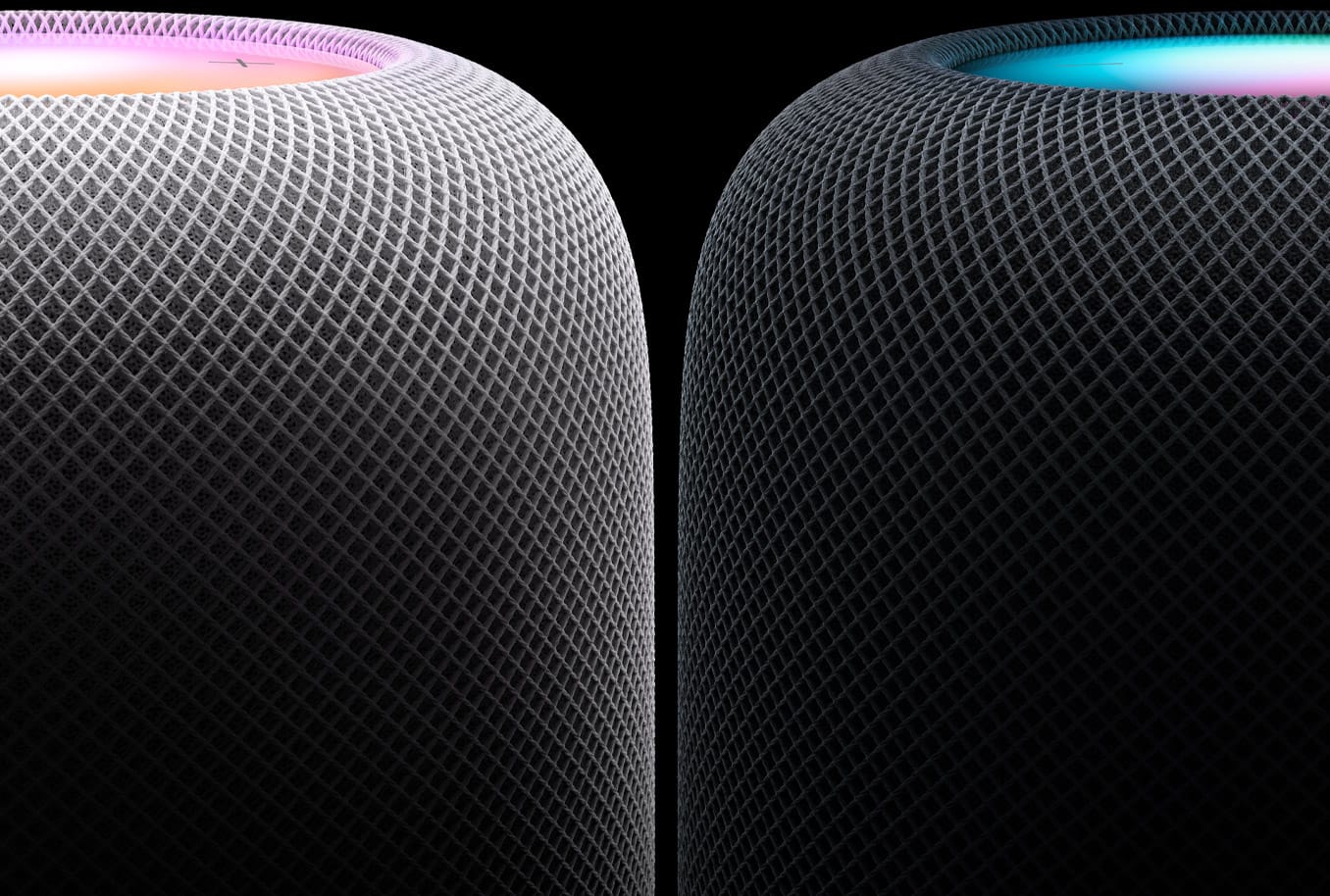
Sound quality. That's the headline, and it deserves to be. The HomePod 2nd generation packs a high-excursion 4-inch woofer and five horn-loaded tweeters arranged in an array around the base, each with its own neodymium magnet. The speaker uses computational audio powered by the S7 chip to analyze the room acoustics in real time, bouncing test tones off walls and adjusting the output profile so it sounds good whether you've placed it in a corner, against a wall, or on a kitchen island.
Play a Spatial Audio track from Apple Music and the effect is immediately noticeable. The tweeters beam direct audio — lead vocals, spoken dialogue — straight at you while reflecting ambient sounds off the walls. The result is a sense of space that a single-point speaker has no business producing. Bass goes deep for a speaker this size, too. Not subwoofer deep, but deep enough that you feel kick drums and synth bass lines in your chest at moderate volume.
If you pair two HomePods as a stereo pair and use them as home theater speakers with an Apple TV 4K, you get Dolby Atmos surround. I will say: that setup genuinely competes with budget soundbar systems costing twice as much. The separation between left and right channels is distinct, and dialogue stays anchored to the center of the screen. It's the kind of feature that makes you wonder why Apple doesn't talk about it more.
Beyond sound, the HomePod functions as a HomeKit, Matter, and Thread smart home hub. It supports Thread border routing for Thread-based accessories, which means your smart home devices communicate directly with the HomePod even when your internet is down. The built-in temperature and humidity sensors can trigger automations — turn on a fan when the room hits 78 degrees, for example. If you're building a whole-home audio system with multiple HomePods, AirPlay 2 handles multi-room playback, and the Intercom feature lets you broadcast messages between rooms.
Where the HomePod falls apart in 2026
Siri. I have to start here because it is the single biggest reason people return the HomePod or stop using it as anything more than an expensive AirPlay speaker. Siri on the HomePod mishears commands regularly, gives confidently wrong answers, and cannot do things that Alexa and Google Assistant figured out years ago.
Ask Siri to set the volume to 22 percent and there's a real chance it cranks it to 100. Ask it to play a specific song and it might play a completely different track by a different artist. Ask it a factual question and the response is often "here's what I found on the web" — except the HomePod has no screen, so that answer is useless. Alexa on the Echo Studio handles every one of these tasks correctly, and it costs $100 less.
This is not a small complaint. It is the core interaction model of the device.
Then there's the Wi-Fi situation. The HomePod 2nd generation uses Wi-Fi 4 — 802.11n. That is the same Wi-Fi standard the iPhone 4 used in 2010. In a 2026 home with dozens of connected devices competing for bandwidth on congested 2.4 GHz and 5 GHz channels, Wi-Fi 4 creates real reliability problems. If your HomePod keeps dropping off your network or connecting to the wrong access point, the ancient wireless radio is almost certainly why. Apple downgraded from Wi-Fi 5 in the original HomePod. That decision made no sense in 2023 and it makes even less sense now.
The S7 chip means no Apple Intelligence support. When Apple ships the enhanced, LLM-powered Siri — reportedly later this year — the HomePod almost certainly will not get it. The new Siri requires at least an A17 Pro with 8 GB of RAM. The HomePod's S7 chip has 1 GB. Apple has not confirmed this limitation, but the math doesn't work.
 Ad
AdThe Spotify problem is worse than you think
Apple Music works natively on the HomePod. Say "Hey Siri, play jazz" and it plays jazz from Apple Music instantly, in lossless quality with Spatial Audio when available. That experience is genuinely seamless.
Spotify does not work natively. At all. Despite Apple opening the HomePod to third-party music services in 2020, Spotify has never implemented native support. The only way to play Spotify on the HomePod is to AirPlay from your iPhone. Your iPhone must be powered on, connected to the same Wi-Fi network, and within range. If you leave the house with your phone, playback stops. If your phone locks and the AirPlay session times out, playback stops. If your kid picks up your phone and opens YouTube, playback stops.
Pandora, Deezer, iHeartRadio, and TuneIn do work natively. But let's be honest: if you're a Spotify household, the HomePod asks you to change your entire music setup or live with a clunky workaround. The Sonos Era 100 and Amazon Echo Studio both support Spotify, Apple Music, YouTube Music, Tidal, and Amazon Music natively. No phone required.
How the HomePod compares to the competition
If you compared the HomePod against Alexa speakers purely on voice assistant quality and music service support, the HomePod loses. Badly. But the buying decision is more complicated than that, because the HomePod does things its competitors cannot.
Here's how the HomePod stacks up against its closest competitors at similar price points.
| Feature | HomePod 2nd Gen | Sonos Era 100 | Amazon Echo Studio |
|---|---|---|---|
| Price | $299 | $249 | $199 |
| Spatial Audio / Dolby Atmos | Yes | No (Era 300 does) | Yes |
| Bluetooth Audio | No | Yes | Yes |
| Native Music Services | Apple Music only | All major services | All major services |
| Smart Home Hub | HomeKit + Matter + Thread | No | Alexa + Matter + Zigbee |
| Voice Assistant Quality | Weak (Siri) | Decent (Alexa) | Strong (Alexa) |
The Sonos Era 100 at $249 is the closest competitor in sound quality. Sonos multi-room audio is more reliable than AirPlay in my experience, and it supports every major streaming service natively. But the Era 100 is not a smart home hub. It has no Thread radio, no temperature sensor, and no HomeKit integration beyond basic AirPlay. If your smart home runs on Apple Home, the Sonos cannot replace the HomePod's hub function.
The Amazon Echo Studio at $199 offers Dolby Atmos, Alexa (which is significantly better than Siri for voice commands), native support for every major music service, and it doubles as an eero Wi-Fi mesh satellite. It even has Bluetooth audio, which the HomePod inexplicably lacks. If you are not deeply invested in the Apple ecosystem, the Echo Studio is the better value.
My honest take: the HomePod justifies its price only if you meet two conditions. You use Apple Music as your primary streaming service, and you use HomeKit as your smart home platform. If either of those is not true, the Sonos or Echo Studio will serve you better for less money.
The HomePad question hanging over every purchase
Apple is reportedly preparing a new smart home device — a 7-inch display with an A18 chip, Face ID, built-in speakers, and full Apple Intelligence support. Bloomberg and multiple supply-chain reports place its launch sometime this spring. If that device ships at the rumored $350 price point, it would offer everything the HomePod does as a smart home hub plus a touchscreen, a dramatically more capable processor, and the enhanced Siri that the HomePod will never receive.
Will the HomePad sound as good as the HomePod? Almost certainly not. A 7-inch tablet with integrated speakers will not match a dedicated speaker with a 4-inch woofer and five tweeters. But for people who want smart home control, Siri voice commands, timers in the kitchen, and background music — the HomePad might be close enough. And its AI capabilities would be in a different universe.
Buying a $299 HomePod in March 2026, weeks before Apple potentially announces its replacement as a smart home hub, is a risky move. If you only want the HomePod for its speaker quality and you're confident sound is your priority, buy it. It will still sound excellent regardless of what Apple announces. But if you're buying it primarily as a smart home controller, waiting is the smarter play.
Who should buy a HomePod right now
- Apple Music subscribers who want the best single-speaker audio experience in their Apple Home ecosystem.
- Apple TV 4K owners who want a stereo pair for affordable Dolby Atmos home theater without a soundbar.
- HomeKit users who need a Thread border router and home hub with temperature automation — and don't want to wait for unannounced products.
Who should wait or skip it entirely
- Spotify households. The workaround is not worth $299.
- Anyone who primarily wants a voice assistant. Siri on the HomePod is the weakest smart speaker voice assistant you can buy.
- Buyers who want Apple Intelligence features. The HomePod's S7 chip will not support them.
- People who can wait 2-3 months to see what the HomePad announcement looks like.
One last thing that bugs me. The touch surface on top of the HomePod no longer illuminates the volume controls the way the original did. In a dark room, adjusting volume means tapping blindly at the general area of the plus and minus zones and hoping you hit the right one. It's a small thing, but it's the kind of tactile friction that reminds you Apple designed this hardware three years ago and hasn't revisited it since. You can always say "Hey Siri, volume 40 percent" instead — assuming Siri hears you correctly, which, as we've covered, is not guaranteed.
If you're considering a factory reset before selling or giving away your current HomePod, that process is straightforward. And if the sound quality alone is what draws you in, the HomePod delivers on that promise every single day. The Apple S7 chip may be outdated for AI tasks, but it drives those five tweeters and that 4-inch woofer with the kind of precision that makes a $299 speaker sound like it costs twice as much. According to Apple's HomePod technical specifications, the speaker supports Hi-Res Lossless at 24-bit/192 kHz — a spec most competing smart speakers cannot match.
The HomePod is a speaker caught between what it is and what Apple's next move might make it. Buy it for the sound. Skip it for the smarts.

Related Posts
Apple TV Just Became the Only Way to Watch F1 in America
Mar 07, 2026
Apple HomePod Gen 1 vs Gen 2: Which Speaker Deserves a Spot in Your Home
Mar 06, 2026
Your Wyze Cameras Work in Apple Home, but Only If You Build the Bridge Yourself
Mar 05, 2026